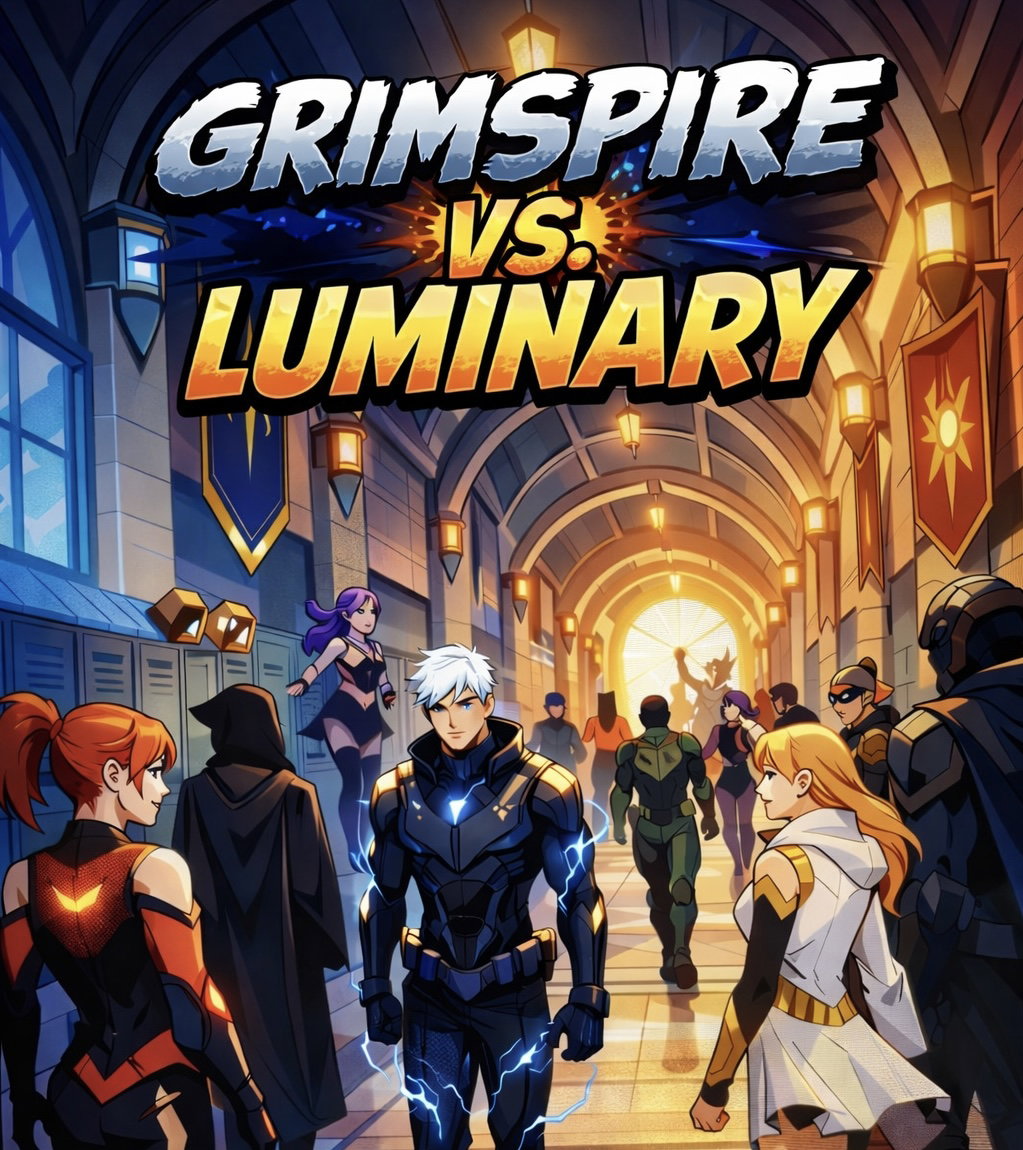
Grimspire Vs Luminary
Halcyon Rift is a city built on tension, spectacle, and the constant hum of controlled conflict. Its upper districts rise in gleaming tiers of metal and glass, where skylanes weave between towers and civic plazas glow with polished order. Far below, the Underveil twists through old industrial caverns and forgotten tunnels, a maze of neon haze, stone corridors, and repurposed machinery. The city survives because these two halves coexist, each shaped by the presence of its rival academies: Luminary above, Grimspire below, their influence woven into every street, law, and tradition. Luminary Institute stands on a terraced plateau overlooking the skyline, its bright angular towers and floating grav‑platform arenas projecting discipline and aspiration. Every part of the academy reinforces its mission: to train heroes who can protect the world. Students practice rescue operations, tactical coordination, power control, and public service. The academy’s culture is built on structure and responsibility, and the city views Paragon as its shield, the institution that keeps the upper districts safe and stable. Grimspire Academy, carved deep into the Underveil’s bedrock, is its opposite in every way. Gothic spires, cold blue lighting, and iron‑bound halls create an atmosphere of ambition sharpened by danger. Apex trains villains under strict supervision, channeling destructive potential into controlled competition. Students study subterfuge, psychological warfare, combat arts, and creative problem‑solving that often borders on the unhinged. The academy is sanctioned because it keeps aspiring villains contained, monitored, and too focused on outperforming Paragon to destabilize the world beyond Halcyon Rift. The rivalry between the academies is the heartbeat of the city. It is ritualized, regulated, and deeply cultural. Annual Trials turn Halcyon Rift into a sprawling arena where teams from both schools clash in escalating challenges broadcast worldwide. Propaganda Wars erupt each semester as both institutions flood the city with holograms, posters, and digital campaigns. Sanctioned Duels allow one‑on‑one combat under strict rules, while Civic Intervention Exercises pit Luminaires rescue operations against Grimspire’s attempts to complicate or sabotage them. The conflict is fierce, but boundaries are enforced; breaking them risks severe city sanctions and loss of prestige. Academic life revolves around events designed to pressure, test, and refine students from both sides. Midterm Gauntlets run parallel obstacle courses that occasionally intersect in ways neither academy officially acknowledges. Urban field trips deploy students into the city for rescue drills, infiltration tests, artifact retrieval missions, or crisis simulations that often overlap with their rivals’ objectives. Rift Week transforms Halcyon Rift into a festival of demonstrations, exhibitions, and thinly veiled sabotage. Winter Convergence Exams send both academies into the frozen outskirts for survival trials where the environment is as dangerous as the opposing school. Shadow Semester allows Grimspire students to operate covertly in the city while Luminary students attempt to identify and counter them, turning Halcyon Rift into a living chessboard of hidden operations and reactive heroics. The city allows all of this because it must. Halcyon Rift thrives on the balance created by the two academies. Luminary produces heroes. Grimspire produces villains. Their conflict is contained, monetized, and predictable. Without these institutions, superpowered youth would scatter across the world, destabilizing entire regions. Here, their clashes are supervised. Here, the city profits. Here, the world sleeps easier knowing the chaos is confined to a place built to withstand it