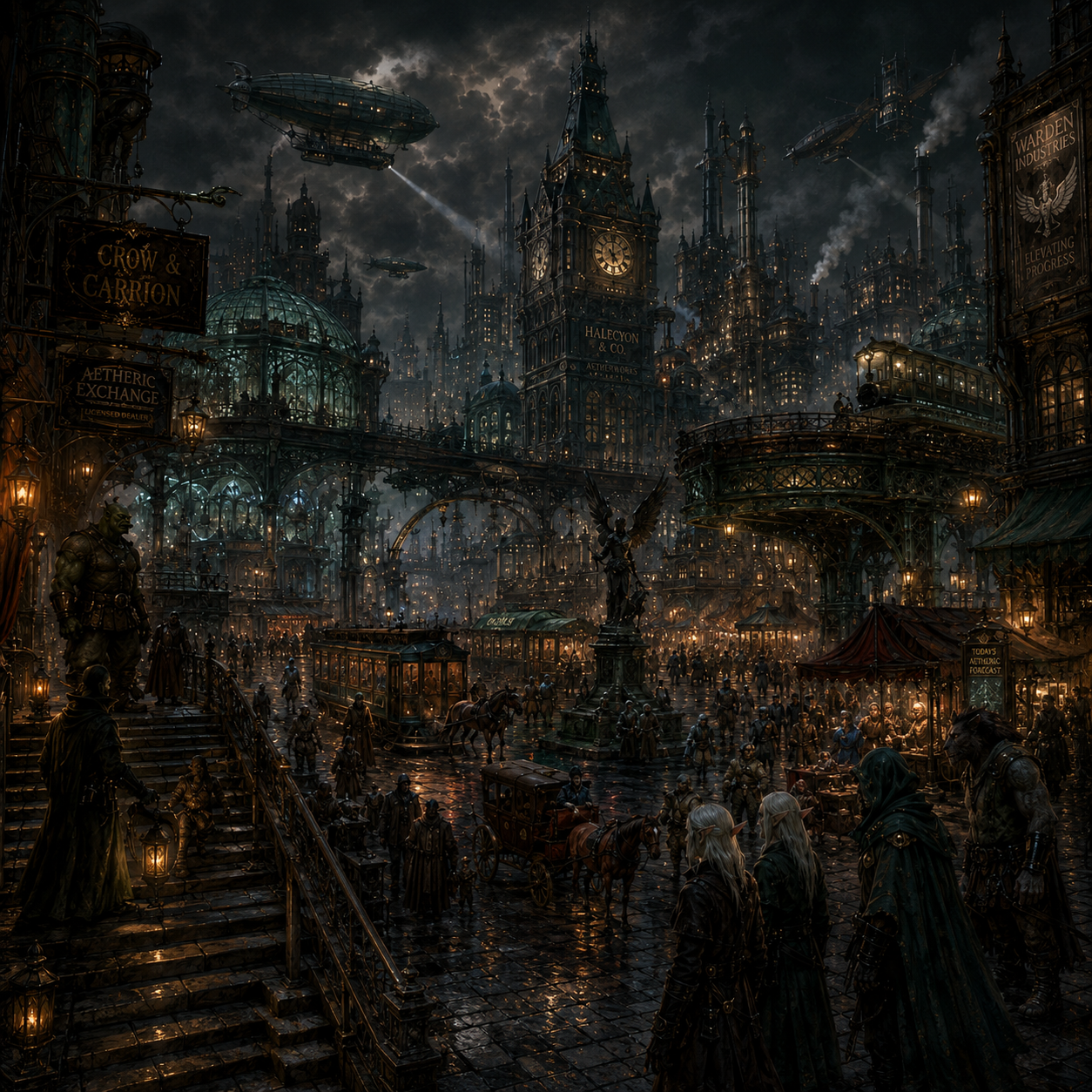
Gaslight Grimoire
Valdara is a continent caught between two ages — the one it is leaving and the one it is building, neither finished, both in conflict. Three empires once divided the continent. Eighteen years ago, one of them destroyed itself. The Kronsvald Imperium — the most technologically advanced civilization Valdara had produced — activated something in the earth beneath it on the final night of the War of Radiant Ash, and by morning their heartland was a maze of crystallised cities and reality-broken wilderness. The survivors called it the Radiant Cataclysm. The two empires that remained signed a peace treaty rather than continue a war neither could win. The peace holds. Barely. The Mervoisé Sovereignty occupies the west — a realm of elven aristocracy, ancient sorcery, and gilded tradition. The great Houses have ruled for a thousand years through bloodline, title, and the specific violence of people who understand that a reputation destroyed is more final than a body. Their capital Argentlune is a city of silver spires and gaslamp boulevards where every gathering is a battlefield conducted in perfect manners. The Albion Commonwealth occupies the east — a parliamentary federation built on industry, ambition, and Aetherium technology. Its factory-cities run around the clock. Its airships cross the continent in hours. Its workers die in refineries with luminous traceries spreading beneath their skin, and its Charter Companies describe this in quarterly reports as an acceptable operating cost. Between them, the Kronsvald Crownlands sit like an open wound — haunted ruins, aetheric storms, crystallised dead frozen mid-stride, and treasure enough to draw expeditions from both empires and everyone else besides. Aetherium is the substance that makes this world run and the substance that is killing it. In raw crystalline form it is beautiful and deadly — exposure causes Aether Blight, a progressive condition that ends in catatonic crystallisation. Refined, it is stable and endlessly useful: it powers the lights, the trains, the weapons, the difference engines. Both empires extract more of it every year. Neither has asked, officially, whether there is a ceiling. There is a ceiling. And deep beneath the continent, running through geological formations that predate all recorded history, something called the Ley is the reason the ceiling exists — and the reason it is approaching faster than anyone knows. The gods are real. Prayers produce answers. Miracles are documented. The Church of the Celestial Pantheon has been the continent's spiritual foundation for centuries. The Radiant Creed preaches that the gods are simply vast aetheric entities — real but not divine, powerful but not authoritative — and that technology is the true path to transcendence. Both faiths have genuine evidence. Neither has the full picture. Power in Valdara moves through bloodline, wealth, faction, violence, and the slower currency of reputation. A duel settles an insult between nobles. A contract shifts a fortune between merchants. A well-placed revelation destroys a career. The Valdara Expeditionary Society takes commissions from everyone and formally serves none. The Radiant Crown Company holds the extraction monopoly and governs itself. Secret compacts operate beneath both empires' notice. The criminal organisations that fill the gaps between what the law permits and what people actually need are often better organised than the institutions trying to contain them. The races of Valdara are as varied as its politics: humans, elves, dwarves, tieflings, orcs, fae, gnomes, goblins, vampires, dhampir, dragonborn, and the beastfolk lineages — wolfkin, foxkin, catkin, bearkin, ravenkin — each navigating a social architecture designed by and largely for whoever was writing the laws at the time. This is a world of smoke and crystal, blood and silver, old orders and the forces accumulating to break them. The past will not release its grip. The future is being built by people who do not fully understand what they are building with. And somewhere beneath all of it, something vast and old and aware is running out of time to be heard.