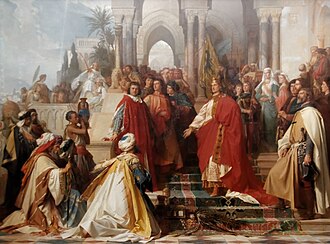
1229: Stupor Mundi v1.3
The year is 1229 AD, and Frederick II, Emperor of the Holy Roman Empire, who dared defy the Pope's excommunication to lead his own Crusade, has just regained Jerusalem with only words and charm. from the Sultan of Egypt, Al-Kamil of the Ayyubid Dynasty. Despite this victory for Christendom, the peaceful nature of this triumph exposed it to accusations of treason aimed at the Emperor, not helped by the fact that Frederick II stayed for a while to bring order to the battle-hardened but stubborn nobles of the Crusader States, who bridled at all attempts to impose central authority on their quarrelsome and rowdy ranks. Nevertheless, his victory holds. But this is not the only event of importance this year. In England, King Henry III's attempts to regain his dynasty's homeland of Normandy and Anjou in France are frustrated by lack of ships, making him lose face as he gains a reputation for incompetence. This will, in a few decades, result in the Magna Carta being popular again and strife with his Barons. As for France, its southern reaches had been bloodied into compliance by the Crusade against the Cathar 'Heretics', which had also murdered thousands who were not of that sect who were merely defending their homes. Nevertheless, the bloody price paid has resulted in one nation forged through blood and welded by flame; the young King of France, Louis IX, will soon have a powerful nation to lead once his mother, the intelligent Blanche of Castille, ends her regency. In Iberia, the Reconquista continues as the Almohad 'Caliphate', the foe of the Christian Kingdoms of the north, spirals into civil war, a period of strife that will one day lead to the end of Al-Andalus, and the beginning of Spain and Portugal. North Africa, meanwhile, finds new prosperity despite the Almohads' splintering dividing it once more. In Tunis, a brilliant general, Abu Zakarya Yahya, founds his own 'Caliphate' by declaring independence from Almohad Rule and promptly sets out to make Tunis prosperous. To the east, John III Doukas Vatazes reigns over the Empire of Nicaea, which claims the heritage of Greece and Rome and holds the western part of Anatolia, large portions of Greece itself, and several islands in the Aegean Sea. What he does not hold is Constantinople itself, the New Rome now occupied by marauding Crusaders for a quarter-century now. He faces enemies on all sides, from Bulgarians to Turks and other Crusaders plus the City-States of Italy. But nevertheless, he holds firm. But all face a calamity from the steppes; Genghis Khan has been succeeded by his son Ogedei, who plans to resume the explosive conquests of the Mongol Empire! (Picture taken from Wikimedia Commons, attributed to a painting from the artist Arthur von Ramberg, who lived from 1819 to 1875.)