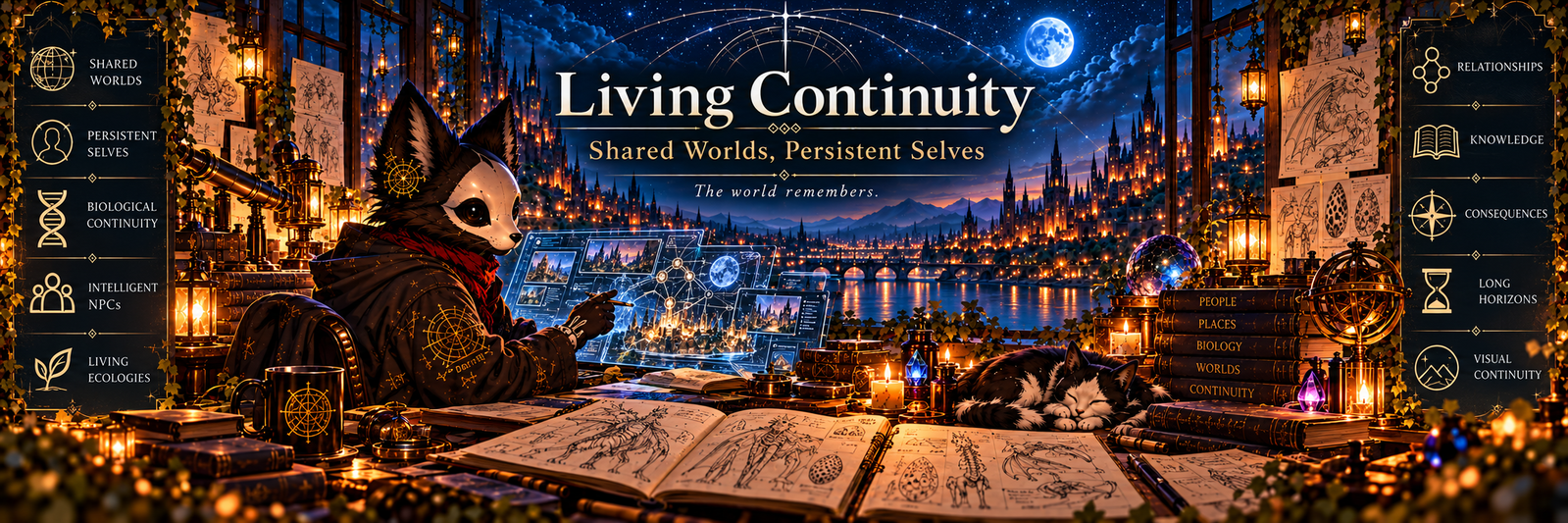
test of Living Continuity 6.8 — Shared Worlds, Persistent Selves
Living Continuity makes Voyage worlds feel like they keep existing between scenes—and V6.8 expands that idea into persistent shared worlds. LC maintains continuity across time, weather, locations, relationships, knowledge, memories, schedules, quests, biology, possessions, projects, consequences, NPC goals, capabilities, and long-running world changes instead of letting important details quietly reset. One of the biggest changes since V4.2 is multiplayer continuity. LC no longer assumes one player owns every important event. A shared session can maintain one coherent world while separately remembering which player learned something, made a promise, changed a relationship, caused a consequence, advanced a capability, or participated in an event. Players can leave and return without losing their established continuity, while NPCs, world state, time, schedules, goals, and shared events remain consistent for everyone. Persistent Selves Primary Character Continuity gives important companions, rivals, hatchlings, children, nonhumans, AIs, and other major NPCs deeper long-term identities. LC can preserve temperament, attachment and autonomy, curiosity, persistence, stress and recovery patterns, communication habits, sensory preferences, likes and dislikes, boundaries, contradictions, goals, coping strategies, and changing priorities. Characters can develop without being randomly rewritten. Their deeper psyche remains persistent while a compact working summary focuses on what currently matters. Living NPCs and Relationships Important NPCs can maintain independent goals and off-screen lives rather than existing only when the player is present. LC tracks evidence-backed progress, blockers, schedules, obligations, reunions, relationship changes, rupture and repair, while avoiding invented accomplishments simply because time passed. Identity, Biology, and Visual Continuity Entity Semantics preserves identities, aliases, local roles, significance, lifecycle changes, presentation, exposure, and observer-specific beliefs. Biological Continuity keeps species, morphology, developmental state, phenotype, anatomy, persistent changes, current condition, and presentation from drifting. Visual Continuity applies the same principle to portraits, keeping stable character identity separate from pose, framing, expression, lighting, and scene depiction. Shared World Systems LC includes reusable systems for processes, needs, accumulators, schedules, projects, links, knowledge, quests, consequences, capabilities, NPC intentions, world events, and forecasting. Long Horizons carries plans, deadlines, appointments, developing situations, and NPC goals forward without treating forecasts as fate. Context and Scene Bandwidth systems help surface what matters while allowing quiet scenes to remain quiet. Commands, HUD, and Runtime Control V6.8 adds an LC command-intersection layer so LC commands can be treated as interface input rather than character dialogue. Command-only turns can avoid advancing LC simulation state, while mixed inputs can separate configuration commands from the player's actual fictional action. The configurable HUD can display compact date, weekday, digital time, weather, temperature, and location information. World creators can also configure moderation behavior, strike count, action handling, subsystem behavior, and other runtime policy. Forge and Host Control The shared LC Forge Kernel handles maintenance and optional policy compilation without requiring every feature to become another permanent runtime system. LC remains modular and host-safe. The host world stays authoritative over its lore, characters, mechanics, quests, progression, biology, tone, and rules. LC supports the world you already built rather than replacing it. The world remembers. The people remember. Players can share the same world without losing who did what. And the world can keep developing even when nobody is looking. **LC Wiki** https://living-continuity-wiki.cowpie646652.chatgpt.site